English
- English
- Español
- Português
- русский
- Français
- 日本語
- Deutsch
- tiếng Việt
- Italiano
- Nederlands
- ภาษาไทย
- Polski
- 한국어
- Svenska
- magyar
- Malay
- বাংলা ভাষার
- Dansk
- Suomi
- हिन्दी
- Pilipino
- Türkçe
- Gaeilge
- العربية
- Indonesia
- Norsk
- تمل
- český
- ελληνικά
- український
- Javanese
- فارسی
- தமிழ்
- తెలుగు
- नेपाली
- Burmese
- български
- ລາວ
- Latine
- Қазақша
- Euskal
- Azərbaycan
- Slovenský jazyk
- Македонски
- Lietuvos
- Eesti Keel
- Română
- Slovenski
- मराठी
- Srpski језик

News
Which Steel Materials Are Suitable for Cement Concrete Brick Mold Production?
A block plant manager facing a mold replacement decision is confronted with a confusing array of steel grades. The original mold lasted 80,000 cycles and the replacement quote specifies "55# manganese steel." A competing supplier offers "16Mn steel" at a lower price, and a third proposes "vacuum carburized alloy steel" with a 100,000-cycle warranty. The specifications sound similar, but the performance differences are not. A Cement Concrete Brick Mold is not a simple steel plate. It is a wear component that must resist abrasive aggregate, withstand high-frequency vibration, maintain dimensional accuracy under pressure, and survive hundreds of thousands of forming cycles. The steel selected determines whether the mold delivers its rated life or fails prematurely, and the difference between a good mold and a poor one is measured in production downtime, block quality rejects, and replacement frequency.
This guide is written for buyers who need to make an informed decision about steel materials for Cement Concrete Brick Mold production. We will compare the steel grades commonly used in the industry, explain the role of heat treatment and carburizing, discuss the trade-offs between hardness and toughness, and provide the criteria for evaluating a mold supplier's material claims. We will also provide detailed product parameters from our factory at PRO Industry Group Co., Ltd., including the material specifications and heat treatment processes we use for our molds. Whether you are sourcing molds for hollow blocks, pavers, curbstones, or specialized concrete products, this guide will help you select a mold material that matches your production conditions and your cost targets.
Table of Contents
- 1. What Are the Common Steel Grades Used in Cement Concrete Brick Mold Production?
- 2. Why Is Manganese Steel Still the Industry Standard for Mold Frames?
- 3. When Does Alloy Steel with Vacuum Carburizing Justify Its Higher Cost?
- 4. How Does Heat Treatment Determine the Hardness-Toughness Balance?
- 5. What Are the Material Trade-Offs Between Cost and Service Life?
- 6. How Do You Evaluate a Mold Supplier's Material Claims?
- 7. What Are the Key Product Parameters from Our Factory?
- 8. Frequently Asked Questions (FAQ)
- 9. Conclusion
1. What Are the Common Steel Grades Used in Cement Concrete Brick Mold Production?
The steel grades used in Cement Concrete Brick Mold production fall into three broad categories: structural carbon steels, manganese steels, and alloy tool steels. Structural carbon steels such as Q235B and Q345B are used for the mold frame and base plates, where the primary requirement is rigidity and weldability rather than wear resistance. Manganese steels such as 55# manganese (55Mn) and 16Mn (Q345) are used for the mold cavity, core bars, and tamper heads, where wear resistance and toughness are required. Alloy tool steels such as 42CrMo, Cr12MoV, and Hardox are used for high-wear applications or where extended service life justifies a higher material cost. The table below summarizes the typical applications of each steel category in a Cement Concrete Brick Mold.
| Steel Category | Typical Grades | Mold Component | Primary Property Required |
| Structural Carbon Steel | Q235B, Q345B | Frame, base plate | Rigidity, weldability |
| Manganese Steel | 55Mn, 16Mn (Q345) | Cavity, core bars, tamper head | Wear resistance, toughness |
| Alloy Tool Steel | 42CrMo, Cr12MoV, Hardox | High-wear inserts, core bars | High hardness, extended life |
At PRO Industry Group Co., Ltd., our factory selects steel grades based on the specific mold application, the block type, and the production volume. We do not use a single steel for all molds, because the wear conditions vary significantly between hollow block production, paver production, and curbstone production. Our engineering team works with each customer to determine the optimal material specification for their Cement Concrete Brick Mold.
2. Why Is Manganese Steel Still the Industry Standard for Mold Frames?
Manganese steel, particularly 55# manganese (55Mn) and 16Mn (Q345), remains the industry standard for Cement Concrete Brick Mold frames and cavities for several reasons. First, it offers an excellent balance of hardness and toughness. After heat treatment, 55Mn can achieve a surface hardness of HRC 58-62, which provides good resistance to the abrasive action of concrete aggregate. At the same time, its core remains tough enough to absorb the impact of the tamper head and the vibration of the block machine without cracking. Second, it is readily available and relatively economical compared with alloy tool steels. Third, it has good weldability, which allows for the fabrication of large mold frames and the repair of worn areas.
The limitation of 55Mn is that its hardenability is moderate, and it can be prone to cracking during water quenching if the heat treatment is not carefully controlled. This is why the heat treatment process is as important as the steel grade itself. A mold made from 55Mn with a poorly controlled heat treatment will not achieve its full hardness, or it may develop quenching cracks that lead to premature failure. 16Mn (Q345) is often used for the tamper head and other components where toughness and weldability are more important than maximum hardness. The table below compares the properties of 55Mn and 16Mn for mold applications.
| Property | 55Mn | 16Mn (Q345) |
| Typical Surface Hardness (after heat treatment) | HRC 58-62 | HRC 58-62 (carburized) |
| Toughness | Moderate | Excellent |
| Weldability | Moderate | Good |
| Quenching Crack Risk | Moderate to high | Low |
| Typical Mold Component | Cavity, core bars | Tamper head, frame |
At our factory, we use 55Mn for the mold cavity and core bars where wear resistance is the priority, and 16Mn for the tamper head and frame components where toughness is more important. We control the heat treatment process carefully to achieve the specified hardness without introducing quenching cracks. Our quality control team verifies the hardness of every production batch.
3. When Does Alloy Steel with Vacuum Carburizing Justify Its Higher Cost?
Alloy steel with vacuum carburizing is the premium option for Cement Concrete Brick Mold production. It is specified when the production volume is high, the aggregate is highly abrasive, or the block design requires a mold that maintains tight dimensional tolerances over an extended service life. The carburizing process creates a hard surface layer (typically HRC 60-65) with a depth of 1.2-1.35 mm, while the core remains tough (HRC 33-40). This "hard shell, tough core" structure is the key to extended mold life. The hard surface resists the abrasive wear of the concrete, while the tough core absorbs the impact and vibration without cracking. The table below compares the performance of standard manganese steel and vacuum-carburized alloy steel molds.
| Parameter | Standard Manganese Steel | Vacuum-Carburized Alloy Steel |
| Surface Hardness | HRC 58-62 (through-hardened or surface) | HRC 60-65 (carburized case) |
| Case Depth | N/A | 1.2 - 1.35 mm |
| Core Hardness | HRC 33-40 (typical) | HRC 33-40 (controlled) |
| Typical Service Life | 50,000 - 80,000 cycles | 90,000 - 100,000+ cycles |
| Relative Cost | Baseline | 20-40% higher |
At PRO, our factory uses vacuum carburizing and integral heat treatment for our premium mold line. The process is controlled by a German PE system, which monitors the carbon potential and the case depth in real time. Our insert hardness reaches HRC 60-65, and the carburizing layer thickness is 1.2-1.35 mm. We back this with a service life warranty of up to 100,000 cycles for our paver molds and up to 90,000 cycles for our hollow block molds. For customers producing at high volume, the higher initial cost of the carburized mold is offset by the reduced replacement frequency and the lower downtime.
4. How Does Heat Treatment Determine the Hardness-Toughness Balance?
Heat treatment is the process that transforms the steel from a raw material into a wear-resistant mold component. The goal is to achieve a hard surface that resists abrasion while maintaining a tough core that resists cracking. The two most common heat treatment processes for Cement Concrete Brick Mold are through-hardening and carburizing. Through-hardening involves heating the steel to the austenitizing temperature, quenching it in oil or water, and tempering it to the desired hardness. Carburizing involves heating the steel in a carbon-rich atmosphere, allowing carbon to diffuse into the surface, and then quenching and tempering. The table below compares these processes.
| Heat Treatment | Process | Hardness Achieved | Advantage | Limitation |
| Through-Hardening | Heat, quench, temper | HRC 58-62 (uniform) | Simple, uniform properties | Core may be too hard, brittle |
| Carburizing | Heat in carbon atmosphere, quench, temper | HRC 60-65 (surface), HRC 33-40 (core) | Hard surface, tough core | More complex, higher cost |
| Nitriding | Heat in nitrogen atmosphere | HRC 60-65 (surface) | Low distortion, high hardness | Thin case, not for high impact |
At our factory, we use vacuum carburizing for our premium mold components and controlled through-hardening for our standard manganese steel components. We verify the hardness and case depth after heat treatment using calibrated hardness testers and metallographic inspection. Our goal is to ensure that every Cement Concrete Brick Mold we produce has the correct hardness-toughness balance for its intended application.
5. What Are the Material Trade-Offs Between Cost and Service Life?
The material selection for a Cement Concrete Brick Mold involves a trade-off between initial cost and service life. A standard manganese steel mold has a lower initial cost but a shorter service life. A vacuum-carburized alloy steel mold has a higher initial cost but a longer service life and lower replacement frequency. The optimal choice depends on the production volume, the block type, and the cost of downtime. The table below presents a simplified total cost of ownership comparison for a hollow block mold.
| Cost Factor | Standard Manganese Mold | Vacuum-Carburized Mold |
| Initial Mold Cost | Baseline | +30% |
| Service Life (cycles) | 60,000 - 80,000 | 90,000 - 100,000 |
| Replacement Frequency (per 500k cycles) | 6-8 molds | 5 molds |
| Downtime per Replacement | 4-8 hours | 4-8 hours |
| Total Cost per 500k Cycles | Higher | Lower |
At PRO Industry Group Co., Ltd., we work with our customers to evaluate the total cost of ownership for their specific production conditions. For a plant producing at high volume with abrasive aggregate, the vacuum-carburized mold is usually the more economical choice over the life of the equipment. For a plant with lower volume or less abrasive aggregate, the standard manganese mold may be sufficient. Our goal is to help our customers select the material that delivers the best value for their operation.
6. How Do You Evaluate a Mold Supplier's Material Claims?
Evaluating a mold supplier's material claims requires more than reading the specification sheet. The buyer should verify the steel grade, the heat treatment process, the hardness, the case depth, and the service life warranty. The supplier should be able to provide material certificates, hardness test reports, and references from customers with similar production conditions. The table below summarizes the verification steps.
| Verification Step | What to Request | Why It Matters |
| Steel Grade Verification | Mill test certificate | Confirms the steel meets the specified grade |
| Hardness Verification | Hardness test report (HRC) | Confirms the heat treatment achieved the target |
| Case Depth Verification | Metallographic report (for carburized molds) | Confirms the carburizing layer thickness |
| Service Life Warranty | Written warranty with cycle limit | Provides recourse if the mold fails prematurely |
| Customer References | Contacts in similar production conditions | Confirms real-world performance |
At our factory, we provide complete documentation for every Cement Concrete Brick Mold we ship, including mill test certificates, hardness reports, and our written service life warranty. We also provide customer references on request. We invite you to verify our material claims against these criteria and to consider us as your partner for mold production.
7. What Are the Key Product Parameters from Our Factory?
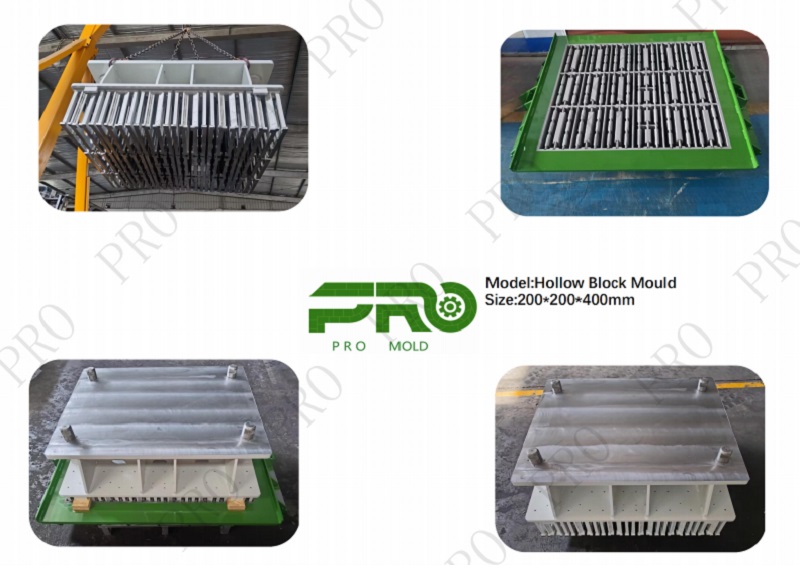
The following table provides the key product parameters for our Cement Concrete Brick Molds, including the steel grades and heat treatment processes we use. Our factory can also customize the material specification to meet specific production requirements.
| Parameter | Specification Range | Notes |
| Frame Material | Q235B, Q345B, 16Mn | Selected for rigidity and weldability |
| Cavity/Core Material | 55Mn, 16Mn, Alloy Steel | Selected for wear resistance |
| Premium Option | Vacuum-Carburized Alloy Steel | HRC 60-65, case depth 1.2-1.35 mm |
| Surface Hardness | HRC 58-62 (standard), HRC 60-65 (premium) | Verified after heat treatment |
| Core Hardness | HRC 33-40 | Maintains toughness |
| Service Life (standard) | 60,000 - 80,000 cycles | Depends on block type and conditions |
| Service Life (premium) | 90,000 - 100,000 cycles | Warranted for paver and hollow block molds |
| Replaceable Components | Yes (bolt structure) | Reduces maintenance downtime |
| MOQ | 1 set | Negotiable for large orders |
| Lead Time | 3 - 6 weeks | Depends on complexity and quantity |
At our factory, we manufacture our Cement Concrete Brick Molds to meet these specifications and more. We can customize the steel grade, heat treatment, and service life warranty to suit your specific requirements. Our quality control system includes inspection of raw materials, in-process inspection, and final inspection before shipment. Our goal is to provide our customers with high-quality molds that deliver reliable performance and long service life.
8. Frequently Asked Questions (FAQ)
Question 1: What is the best steel material for a cement concrete brick mold?
Answer: The best material depends on the production conditions. For standard production with moderate volume, 55# manganese steel with proper heat treatment offers a good balance of hardness, toughness, and cost. For high-volume production with abrasive aggregate, vacuum-carburized alloy steel provides a harder surface and longer service life. At PRO Industry Group Co., Ltd., we help customers select the right material based on their block type, production volume, and cost targets.
Question 2: Why does 55# manganese steel need careful heat treatment?
Answer: 55# manganese steel has moderate hardenability and a tendency to crack during water quenching if the process is not carefully controlled. The heat treatment must achieve the target surface hardness (HRC 58-62) without introducing quenching cracks. At our factory, we control the heating rate, quenching temperature, and tempering cycle to ensure that the mold achieves the specified hardness while maintaining its toughness.
Question 3: How does vacuum carburizing extend mold life?
Answer: Vacuum carburizing creates a hard surface layer (HRC 60-65) with a depth of 1.2-1.35 mm, while the core remains tough (HRC 33-40). This "hard shell, tough core" structure resists abrasive wear on the surface while absorbing impact and vibration without cracking. The result is a mold that lasts 90,000 to 100,000 cycles, compared with 60,000 to 80,000 cycles for a standard manganese mold.
Question 4: Can a worn mold be repaired?
Answer: In some cases, a worn mold can be repaired by welding and re-machining. However, the repair process can affect the heat treatment and the dimensional accuracy of the mold. For high-precision molds or molds with extensive wear, replacement is often the more economical choice. Our replaceable component design allows worn core bars and inserts to be replaced without replacing the entire mold assembly.
Question 5: What is the typical service life of a cement concrete brick mold?
Answer: The service life depends on the steel grade, heat treatment, block type, aggregate abrasiveness, and maintenance. Standard manganese molds typically last 60,000 to 80,000 cycles. Vacuum-carburized alloy molds can last 90,000 to 100,000 cycles or more. At PRO Industry Group Co., Ltd., we provide a written service life warranty for our molds based on the specified material and application.
9. Conclusion
Steel material selection is one of the most important decisions in Cement Concrete Brick Mold procurement. The right steel grade, combined with the correct heat treatment, determines whether the mold delivers its rated service life or fails prematurely. Manganese steels such as 55Mn and 16Mn offer a proven balance of performance and cost for standard applications. Vacuum-carburized alloy steels provide extended service life for high-volume, abrasive production. The key is to match the material to the production conditions and to verify the supplier's material claims through documentation and references. At PRO Industry Group Co., Ltd., our factory has over 15 years of experience in mold manufacturing, and we work with our customers to select the optimal material specification for their specific application.
Whether you are producing hollow blocks, pavers, curbstones, or specialized concrete products, we invite you to contact us to discuss your requirements. We can provide material certificates, hardness reports, and service life warranties. Our commitment to quality and customer satisfaction has made us a trusted partner for block plants around the world.
Contact PRO Industry Group Co., Ltd. today to discuss your Cement Concrete Brick Mold requirements and discover how our material selection can improve your production efficiency and mold service life.
Related News
- How Does Cement Concrete Brick Mold Accuracy Affect the Quality of Finished Bricks?
- What Makes a Customized Concrete Brick Mold the Right Choice for Consistent Production?
- Cement Concrete Brick Shot Blasting Surface Treatment Machine vs Traditional Surface Treatment Methods: Which Solution Is More Efficient?
- How to Choose the Right Paver Concrete Brick Mold for Landscape Projects
- Are Wooden Cement Brick Pallets Costing You More Than You Think?
- Why Choose a Cement Concrete Mixer for Efficient Construction Projects?
Leave me a message